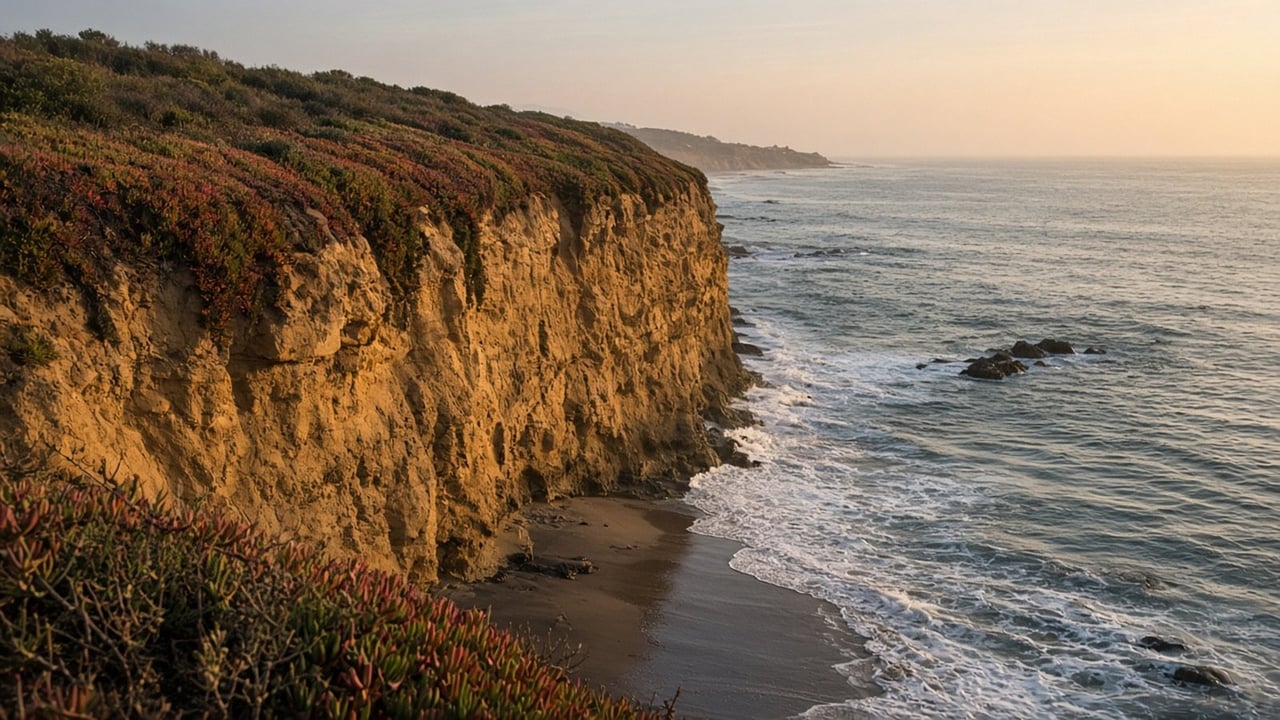
Before buying a bluff top home, read the geotechnical history, the coastal permits, and any recorded deed restrictions, not just the standard disclosures. The state Natural Hazard Disclosure form does not list coastal bluff erosion as a category, and some homes carry recorded waivers of the right to build a seawall.
This article is general information, not legal or tax advice. Please consult a California real estate attorney or CPA about your specific situation.
Does the Natural Hazard Disclosure Cover Bluff Erosion?
No. The Natural Hazard Disclosure Statement in Civil Code 1103.2 covers flood zones, dam inundation, fire hazard zones, wildland areas, earthquake fault zones, and seismic hazard zones, which include landslide and liquefaction. Coastal bluff erosion is not one of its listed categories, so you need to look for it elsewhere.
The form itself warns that its maps "are not definitive indicators" and that buyers "may wish to obtain professional advice regarding those hazards and other hazards that may affect the property." It also states that the statement does not cover all of the seller's disclosure obligations (Civil Code 1103.2, retrieved October 29, 2026).
A seller who knows about bluff failures, past repairs, or engineering reports generally still has to disclose them through the other required disclosures. Ask for every geotechnical report the seller has.
Can I Build a Seawall to Protect a Bluff Top Home?
Not automatically. Coastal Act Section 30235 says seawalls and similar structures shall be permitted to protect existing structures in danger from erosion. The Coastal Commission reads existing structures as those in place on January 1, 1977, and newer homes may carry recorded waivers of any right to shoreline armoring.
In a 2019 Solana Beach staff report, the Commission explained that a home approved in 1996 was not an existing structure under Section 30235. Its owner chose a 25 foot setback instead of 40 feet and waived the right to protect the portion within 40 feet of the bluff edge, recorded through a deed restriction (Coastal Commission Th20b, retrieved October 29, 2026).
The same report tied the life of the approved seawall to the specific homes it protects. Redevelopment, defined as altering 50% or more of a major structural component or adding 50% or more floor area, cumulatively, ends that reliance and must be designed safe without the seawall.
Where Bluff Risk Information Lives
Document | What it tells you | Covers bluff erosion? |
|---|---|---|
Natural Hazard Disclosure (Civil Code 1103.2) | Flood, dam, fire, wildland, fault, and seismic zones | Not a listed category |
Seller disclosures and reports | Known conditions, repairs, engineering | Yes, if known to the seller |
Coastal Development Permits | Approved work and special conditions | Often, through conditions |
Recorded deed restrictions | Waivers, removal duties, assumption of risk | Yes, where recorded |
Your geotechnical report | Current bluff stability and setback | Yes |
What Should I Read During Escrow?
Read the full permit history, any recorded Coastal Commission conditions, and every engineering report, then have your own geotechnical engineer review them. Those documents tell you what the home is allowed to rely on, what you may be required to pay, and what you could build later.
The 2019 report shows how large ongoing obligations can be. The approved project carried an in lieu public recreation fee of $127,786 and a sand mitigation fee of $29,669 for an initial 20 year period, with reassessment required before each period ends (Coastal Commission Th20b, retrieved October 29, 2026). Those figures belong to that project only.
When we help buyers on the bluff, we start with a title search to determine the frontage and how much land you actually own toward the shore, which is a major factor. We also review the bluff maintenance history and any soil tests.
Bluff Top Buyer Checklist
- Order a preliminary title report and read every recorded Coastal Commission deed restriction.
- Request all Coastal Development Permits for the home and any seawall.
- Ask whether the home predates January 1, 1977, or was later redeveloped.
- Collect every geotechnical and monitoring report the seller has.
- Hire your own geotechnical engineer to review bluff stability.
- Ask the city about the Geologic Setback Line for your planned remodel.
- Confirm insurance and lender acceptance before contingency removal.
How Do Remodel Plans Change on a Bluff Lot?
On a bluff lot, a large remodel can count as redevelopment and trigger today's setback rules. In Solana Beach, the certified Land Use Plan requires new development to sit landward of the Geologic Setback Line, and the 50% thresholds are cumulative over time. Plan your remodel before you buy, not after.
Solana Beach Land Use Plan Policy 4.17, quoted in the Commission report, requires new development and additions on bluff property to be landward of the Geologic Setback Line, with at grade decks no closer than five feet from the bluff edge.
Other cities set their own numbers. Del Mar's code (DMMC 30.55.080) sets a 40 foot minimum setback from the top of the bluff for new or redeveloped structures, 10 feet for fences and benches, and no grading within 40 feet (relayed, Del Mar Municipal Code). Encinitas's coastal bluff rules (EMC 30.34.020) reference a 40 foot general setback that can be reduced to 25 feet in limited cases; confirm how it applies to a specific lot with the City of Encinitas (relayed, Encinitas Municipal Code).
Frequently Asked Questions
Here are direct answers to the questions buyers ask us most about this topic. Each answer is based on the sources listed below, retrieved October 29, 2026. Where a detail depends on your situation, the answer says so, and we are glad to walk through yours in a short conversation.
Does the California NHD disclose coastal bluff erosion?
No. The Natural Hazard Disclosure Statement covers flood, dam inundation, fire, wildland, earthquake fault, and seismic hazard zones. Coastal bluff erosion is not a listed category, so buyers should review seller reports, permits, and a geotechnical evaluation.
Can a Solana Beach bluff home build a seawall?
Only with a Coastal Development Permit. Coastal Act Section 30235 allows protection for existing structures in danger from erosion. Homes built after the Coastal Act may not qualify, and some carry recorded waivers of any right to shoreline armoring.
What is a seawall waiver?
It is a permit condition, usually recorded as a deed restriction, in which an owner gives up the right to build shoreline protection for part or all of a home. It runs with the land, so it binds you as the next owner.
What counts as redevelopment on a Solana Beach bluff lot?
In the Commission's 2019 Solana Beach report, redevelopment means altering 50% or more of a major structural component, or adding 50% or more floor area, counted cumulatively over time. Redeveloped homes must be safe without relying on a seawall.
Should I get my own geotechnical report on a bluff home?
Yes. Seller reports are a starting point, but your own engineer can assess current stability, setback lines, and how your plans fit. Schedule it early in escrow so the results arrive before your contingency deadline.
Sources
- California Civil Code Section 1103.2, Natural Hazard Disclosure Statement, leginfo.legislature.ca.gov, retrieved October 29, 2026
- California Public Resources Code Section 30235 (Coastal Act), leginfo.legislature.ca.gov, retrieved October 29, 2026
- California Coastal Commission, Staff Report Th20b, CDP 6-18-0288, 235 to 245 Pacific Avenue, Solana Beach (hearing March 7, 2019), documents.coastal.ca.gov, retrieved October 29, 2026
- Del Mar Municipal Code 30.55.080, bluff setback (relayed from Marketing Director browser check, October 29, 2026; codepublishing.com blocked our fetch)
- Encinitas Municipal Code 30.34.020, coastal bluff overlay (relayed from Marketing Director browser check, October 29, 2026; codepublishing.com blocked our fetch)
This article is general information, not legal or tax advice. Please consult a California real estate attorney or CPA about your specific situation.